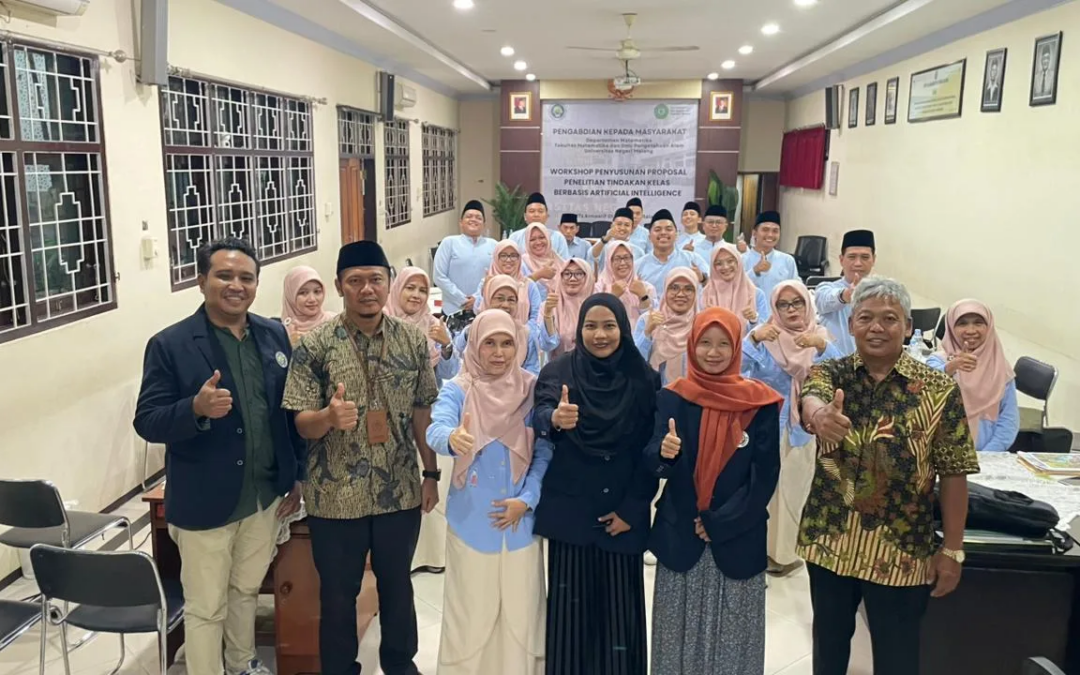

The commitment to providing adaptive and globally competitive education was reaffirmed through a strategic collaboration between doctoral students of Mathematics Education at Universitas Negeri Malang and MTs Almaarif 01 Singosari, Malang Regency, on Friday (10/4/2026). This collaboration was realized in a community service program in the form of a Workshop on Drafting Classroom Action Research (CAR) Proposals based on Artificial Intelligence (AI), as a response to the real needs of teachers amidst the digital transformation of education.
This activity was initiated by a team of PhD students in Mathematics Education, namely Konstantinus Denny Pareira Meke, M.Pd., Ulfa Masamah, M.Pd., and Wiga Ariani, M.Pd., under the academic supervision of Dr.rer.nat. I Made Sulandra, M.Si. The implementation of the activity was also supported by a team of competent lecturers, namely Dr. Tomi Listiawan, S.Si., M.Pd., Mohammad Agung, S.Pd., M.Sc., and Azizah, S.Pd., M.Si., thereby providing a professional development space for teachers that is academically strong and relevant to technological developments.
A total of 40 teachers from MTs Almaarif 01 Singosari participated in the workshop with high enthusiasm. The activity did not only focus on delivering concepts but also emphasized the direct practice of utilizing AI in drafting systematic, contextual, and solution-oriented CAR proposals. This approach reflects a paradigm shift toward evidence-based teaching supported by data and technology.
In his remarks, Dr.rer.nat. I Made Sulandra, M.Si. emphasized the importance of integrating AI into CAR as part of strengthening teachers’ reflective capacity.
“AI is not a substitute for academic reasoning, but rather a catalyst that accelerates the teacher’s scientific thinking process in formulating data-based learning solutions,” he stated.
He also highlighted the urgency of sustainable collaboration between universities and schools as a foundation for building a sustainable and innovative education system.
Appreciation was also expressed by the Head of MTs Almaarif 01 Singosari, Dwi Retno Palupi, M.Pd., who viewed this activity as a concrete step in increasing teacher professionalism.
“This workshop not only enriches insights but also provides practical skills that can be directly implemented in the context of classroom learning,” said Palupi.
Furthermore, Palupi emphasized that the main strength of this activity lay in the applied approach delivered by Dr. Tomi Listiawan, S.Si., M.Pd. as the keynote speaker.
“By introducing the use of structured prompts in AI, this opens new perspectives for teachers in drafting research proposals efficiently without neglecting methodological precision. The emphasis on the balance between technological utilization and the depth of scientific understanding became an important value in this session,” Palupi added.
More broadly, this workshop represents a real practice of knowledge transfer between universities and schools. The results of academic studies do not stop at the conceptual level but are implemented directly to address learning challenges in the field. This activity is also part of the strategic contribution of the Department of Mathematics, FMIPA UM, in strengthening the innovation-based educational ecosystem.
The significance of the activity was further evident in the CAR proposal review session led directly by Dr.rer.nat. I Made Sulandra, M.Si. In that forum, each proposal was analyzed critically and constructively, opening a space for scientific dialogue that enriched insights while improving the quality of the teachers’ research designs. This process reaffirmed the importance of validity, relevance, and significance of research within the context of real teaching practices.
Amidst the acceleration of educational digitalization, this collaboration shows that teacher readiness in adopting technology is a key factor in maintaining learning relevance. AI functions not only as a tool but also as a medium of transformation that encourages the emergence of learning practices that are more reflective, adaptive, and research-based.
In conclusion, the synergy between Universitas Negeri Malang and MTs Almaarif 01 Singosari serves as proof that educational progress is born from equal, visionary, and future-oriented collaboration. From the classrooms in Singosari, this progressive step confirms that the transformation of Indonesian education is not merely discourse, but a growing collective movement—strengthening the role of teachers as agents of change while reinforcing the contribution of educational institutions in building the nation’s superior generation.