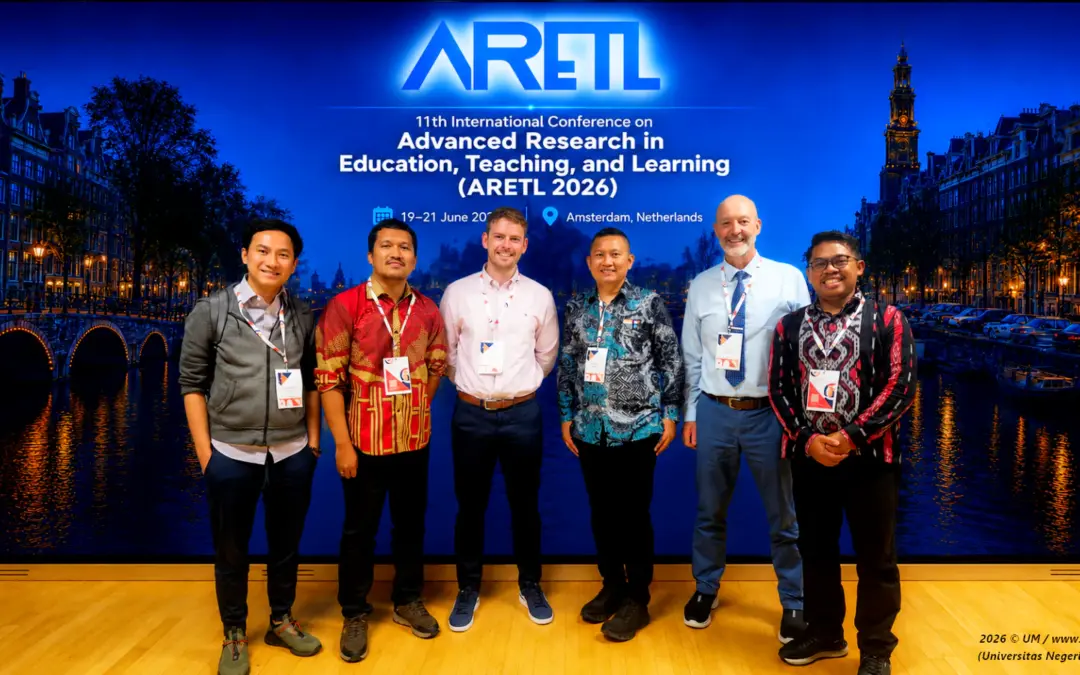

Amsterdam – Universitas Negeri Malang (UM) has once again demonstrated its presence on the international academic stage through the participation of two students from the Doctoral Program in Learning Technology, I Gede Purwana Edi Saputra and Rikardus Feribertus Nikat, as oral presenters at the 11th International Conference on Advanced Research in Education, Teaching, and Learning (ARETL) 2026. The conference, held at the University of Amsterdam, the Netherlands, from Friday through Sunday (June 19–21), served as a platform for both students to present their AI-based research innovations while strengthening UM’s contribution to the development of learning technology on a global scale.
The conference brought together academics, researchers, educational practitioners, and instructional technology developers from various countries, including Austria, Ireland, Brazil, Canada, Slovakia, Hong Kong, China, Georgia, Lithuania, Turkey, and Indonesia. This forum served as a venue to discuss educational transformation, learning innovation, digitalization, and the utilization of Artificial Intelligence in improving the quality of teaching and learning processes.
The participation of these two UM doctoral students is not only an academic achievement but also provides tangible benefits for the development of education in Indonesia. Through this international forum, the developed research results received input from world experts, potentially accelerating the birth of learning innovations that are more adaptive, personal, and aligned with the needs of students in the digital era.
One of the studies presented by I Gede Purwana Edi Saputra is titled Design and Evaluation of Socratic AI-Based Adaptive Scaffolding to Foster Critical Thinking in Secondary Physics Education in Indonesia. This research developed a virtual learning environment model based on an E-Laboratory integrated with Artificial Intelligence to support physics learning at the secondary school level.
Through the Socratic AI-Based Adaptive Scaffolding approach, the AI system does not function as an instant answer provider, but rather as a learning companion that guides students through reflective and adaptive questions. This approach is designed to help students build conceptual understanding while enhancing critical thinking skills in solving physics problems.
Meanwhile, Rikardus Feribertus Nikat presented research titled Artificial Intelligence Perception Acceptance Evaluation Model: Indonesian Students Perspective. This study examines the perceptions and acceptance levels of Indonesian students toward the use of AI in learning through the development of an evaluation model that can serve as a reference for schools and universities in implementing AI technology effectively and centered on student needs.
Gede explained that the development of AI opens up great opportunities to improve the quality of education as long as the technology remains positioned as a support for the teacher’s role.
“Artificial Intelligence is not intended to replace teachers, but to be a partner that helps deliver more adaptive learning. Through the Socratic approach, students do not receive answers directly; instead, they are guided through questions that encourage them to think, analyze, and discover concepts independently,” he stated.
He added that this research is part of his dissertation in the UM Instructional Technology Doctoral Program, which focuses on developing a virtual learning environment based on an E-Laboratory to improve critical thinking skills, conceptual mastery, and student learning experiences.
During ARETL 2026, Gede and Rikardus also engaged in discussions with academics from various countries regarding the development of AI-based educational research. This exchange of ideas opens up opportunities for international collaboration expected to strengthen research quality, expand reputable scientific publications, and accelerate the implementation of learning innovations in Indonesia.
For the UM Instructional Technology Doctoral Program, student participation in international scientific forums is a strategy to strengthen research culture, increase academic competitiveness, and expand partnerships with world universities and research institutions. The impact not only enhances the academic capacity of students but also strengthens the reputation of Universitas Negeri Malang as a university actively producing technology-based educational innovations.
Closing the conference series, Gede expressed his hope that the research results developed could provide a real contribution to the national education world.
“International forums like this are very valuable spaces to learn from world researchers while introducing the research results we have developed at Universitas Negeri Malang. We hope this innovation continues to be refined through international collaboration so that it can provide a real contribution to the development of learning in Indonesia,” he said.
On that occasion, Gede and Rikardus also expressed their appreciation to UM through the International Seminar Assistance Program, which supported the funding of their participation. This support is considered a strategic investment in improving research quality, expanding global academic networks, and strengthening UM’s position as a campus that contributes to the development of science and educational innovation at the international level.
The participation of these two doctoral students is also in line with Sustainable Development Goal (SDG) Number 4 regarding Quality Education through the development of technology-based learning innovations, as well as SDG Number 17 regarding Partnerships for the Goals through the strengthening of research collaboration and international academic networks that encourage the birth of sustainable educational solutions.
Reporter: I Gede Purwana Edi Saputra – UM TEP Doctoral Student
Editor: Muhammad Salmanudin Hafizh Shobirin – UM Public Relations