
Malang — Universitas Negeri Malang (UM) is further strengthening human resource competitiveness in the digital industrial era. Through a Focus Group Discussion (FGD) with De Montfort University, UM has begun preparing a microcredential training program in 3D printing and additive manufacturing, projected to meet future industry needs.
The event, held by UM’s Directorate of Innovation on Monday, May 25, in the Grarek Meeting Room, 3rd Floor, UM, marked a significant moment for strengthening international collaboration based on digital manufacturing technology. The FGD began with a meeting between Dr. Hafiz Ali and UM’s Vice Rector III, Prof. Dr. Markus Diantoro, to discuss strategic cooperation opportunities in education, research, and the development of 3D printing technology.
This collaboration is considered important because additive manufacturing technology is rapidly developing and is now being used in various strategic sectors, ranging from aerospace, automotive, healthcare, to education. This technology enables digital design-based production processes with high precision, material efficiency, and supports faster and more sustainable product innovation.
The Head of the IPTEKS Center of Excellence for Disruptive Learning Innovation (DLI) at UM’s Directorate of Innovation, Dr. Citra Kurniawan, explained that the development of the microcredential program is a concrete step for UM in preparing graduates who are adaptive to global industrial changes.
“This program is designed to strengthen participants’ competencies in digital manufacturing, from operating 3D printing devices, product design, topology optimization, developing lattice structures, to utilizing artificial intelligence in modern material engineering,” he stated.
The FGD also involved various academic elements and innovation developers within UM, including the UM Drone Team, INBISTEK UM, the Center for Science and Engineering (PSR), the Faculty of Engineering, the Faculty of Vocational Studies, and the Faculty of Mathematics and Natural Sciences (FMIPA).
In his presentation, Dr. Hafiz Ali emphasized that mastering 3D printing technology is an urgent necessity amidst global industrial transformation. According to him, this technology not only accelerates production processes but also reduces manufacturing costs and minimizes material waste.
“Additive manufacturing is one of the key technologies in modern industry because it can create more efficient, flexible, and sustainable production systems,” he said.
Not only focusing on technology development, the FGD also highlighted the concept of sustainable additive manufacturing, which is a research focus of De Montfort University. 3D printing technology is considered capable of supporting waste reduction, the use of environmentally friendly materials, and the utilization of recycled materials for future industrial needs.
These efforts are in line with the Sustainable Development Goals (SDGs), particularly SDG 4 on quality education, SDG 9 on industry, innovation, and infrastructure, SDG 12 on responsible consumption and production, and SDG 13 on climate action.
Through this international microcredential program, UM not only expands its global academic network but also opens opportunities for the emergence of new talents in digital manufacturing. Competency-based training is considered capable of enhancing the readiness of students and professionals to face high-tech industry challenges.
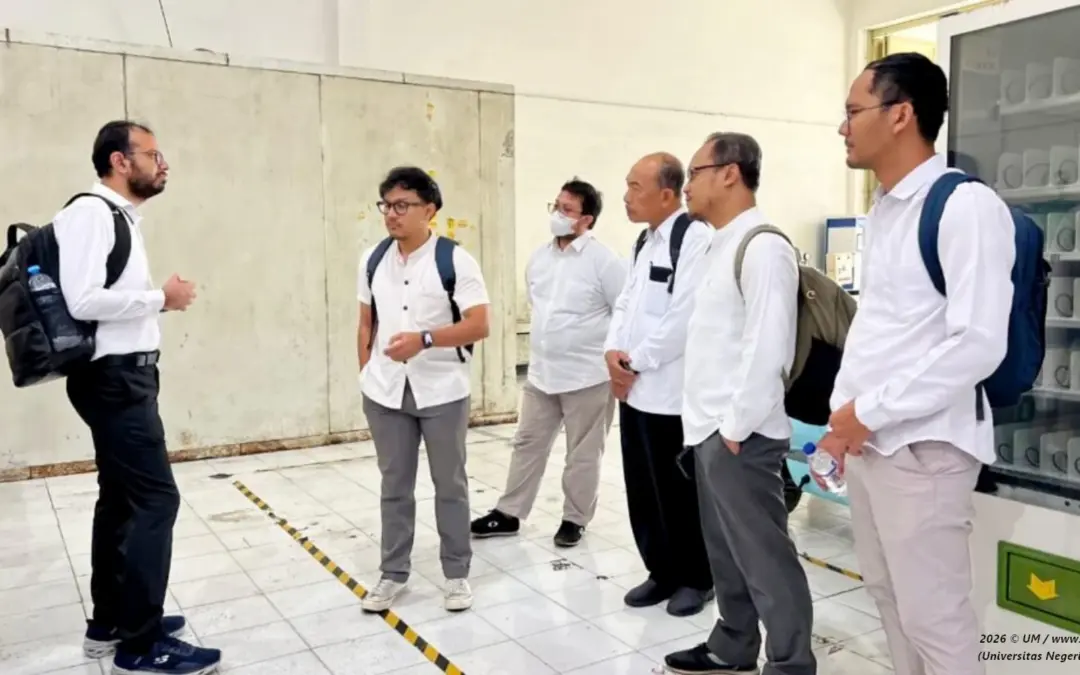
After the FGD, Dr. Hafiz Ali continued his visit to the INBISTEK UM Building, UM Faculty of Engineering, and UM Faculty of Vocational Studies to review the readiness of facilities and 3D printing equipment that will be used in the program’s implementation. This review is an important part of building an innovation ecosystem and strengthening international technology-based collaboration within UM.
Editor: Muhammad Salmanudin Hafizh Shobirin – UM Public Relations