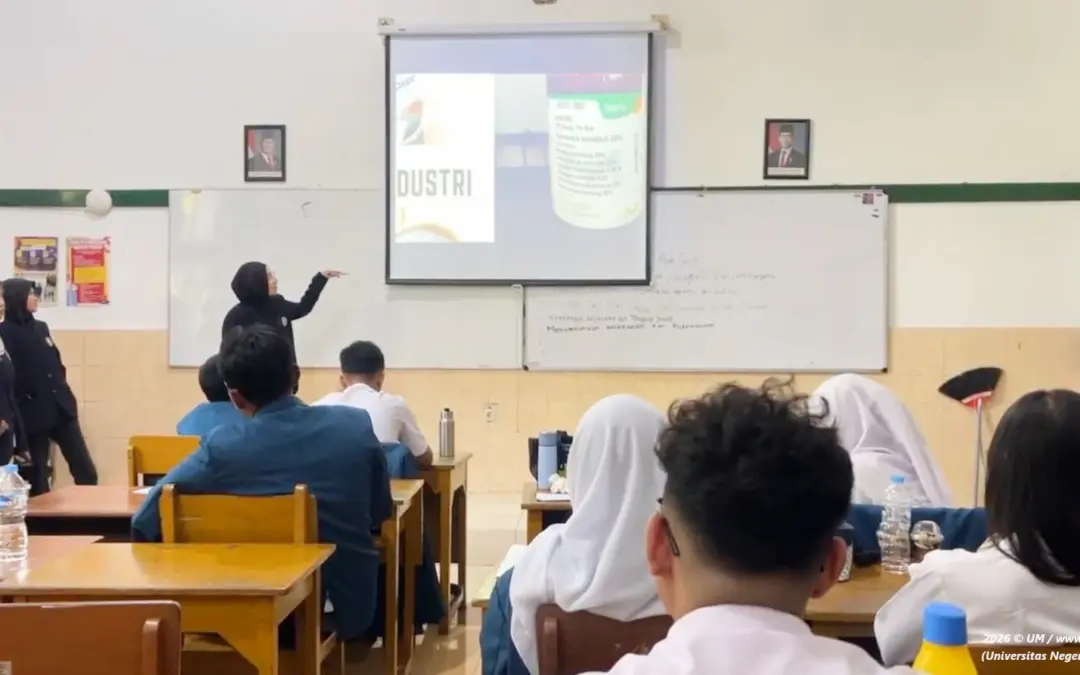

Malang – Capturing attention and bringing a fresh atmosphere to learning, Grade XI students of SMAN 1 Malang are now studying chemistry through the BATIKIN (Nusantara Chemistry Batik) innovation. This local culture-based learning medium was developed by students of Universitas Negeri Malang (UM) to facilitate the understanding of acid-base concepts with a more interactive, engaging, and daily life-relevant approach.
The program, initiated by five students from the Faculty of Mathematics and Natural Sciences (FMIPA) UM—namely, Ayu (S1 Chemistry Education), Ghinan (S1 Chemistry Education), Ais (S1 Mathematics), Pashya (S1 Mathematics), Tasya (S1 Chemistry Education), and Dynar (S1 Chemistry Education)—arose from concerns about the low chemistry literacy among students, especially regarding acid-base concepts, which are often considered abstract and difficult to grasp. Through BATIKIN, chemistry concepts are conveyed by integrating learning, simple practical experiments, and the cultural value of batik as a local identity.
“Chemistry learning should be perceived as beneficial by students, not merely memorized,” stated the BATIKIN development team during a socialization event for class XI-G at SMAN 1 Malang on Monday (April 27).
This activity also aligns with the Sustainable Development Goals (SDGs), particularly SDG 4 on quality education.
The BATIKIN development process began with a literature study from January 27 to February 7, 2026, followed by media concept planning from January 31 to February 10, 2026. Media production was carried out intensively from March 15 to April 15, 2026, after which the socialization was held at SMAN 1 Malang before evaluation from April 27 to April 30, 2026.
During the socialization activity, students first completed a pre-test via Google Form to assess their initial understanding. Out of 20 respondents, 42% answered perfectly, while the remaining 58% still struggled to differentiate between weak and strong bases and to understand the properties of everyday substances. Initial results also showed that 74% of students had a positive attitude towards chemistry learning, although 26% still considered the subject difficult and uninteresting.
Following this, students received a brief explanation of acid-base and salt concepts, their properties, and acid-base indicators. The material presentation was interspersed with simple questions to keep students engaged and prevent boredom. The next stage involved introducing the Ethnochem Kit, which contained a guide book, cotton swabs, batik drawing paper, turmeric as a natural indicator, and sample solutions such as vinegar and soap.
In the core session, students were divided into five groups to conduct batik experiments based on acid-base concepts. Turmeric solution was applied to the batik-patterned paper, then acid and base samples were drawn using cotton swabs. Through this process, students could directly observe color changes in response to the properties of the solutions used. When the turmeric indicator was exposed to a base, its color changed to reddish-brown, while in an acid solution, it turned light yellow.
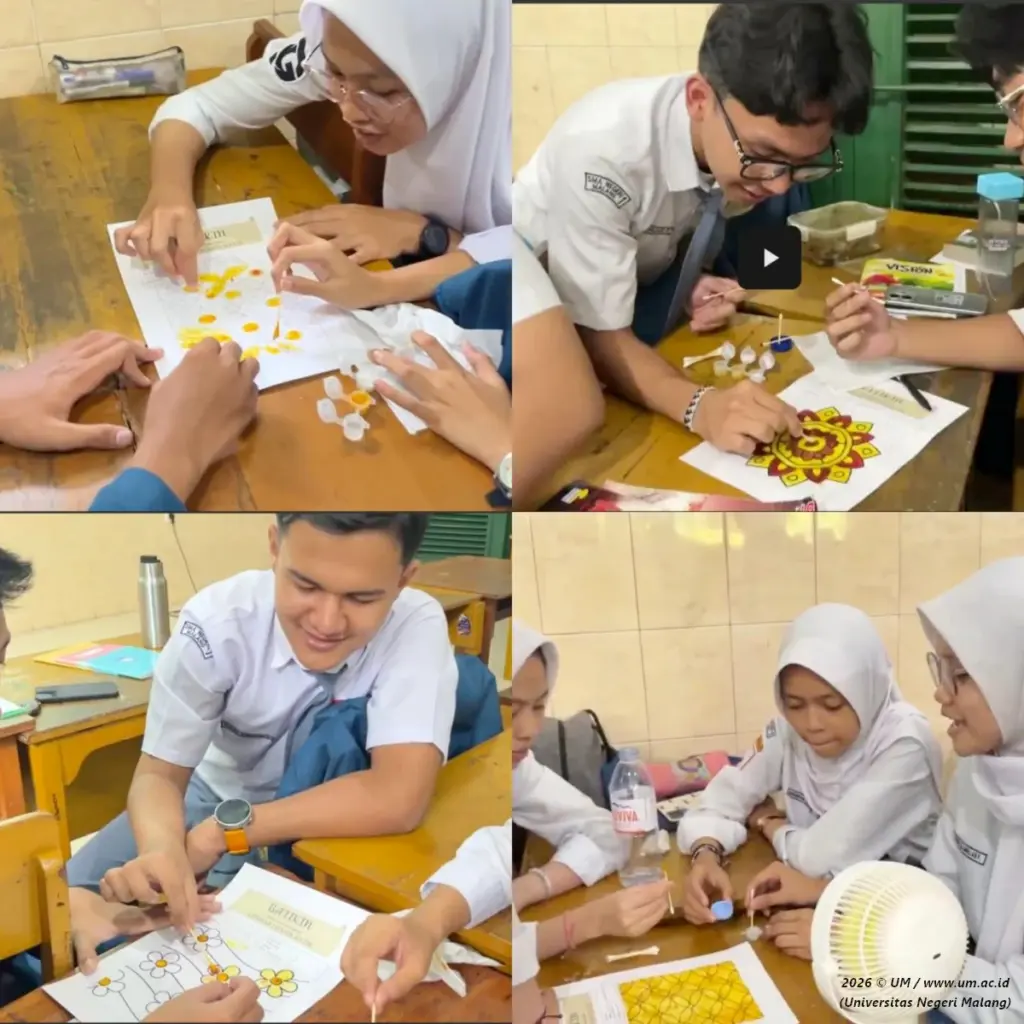
This activity made chemistry learning more vibrant by not only emphasizing concepts but also highlighting batik art as part of Nusantara culture. This approach strengthened the learning context while fostering pride in local heritage.
The final evaluation through a post-test showed improved results. The average student score increased to 94.5. A total of 59% of students answered perfectly, an increase from 42% in the pre-test. The majority of students, approximately 80–89%, also demonstrated a good understanding of acid-base concepts, including neutralization reactions and pH determination.
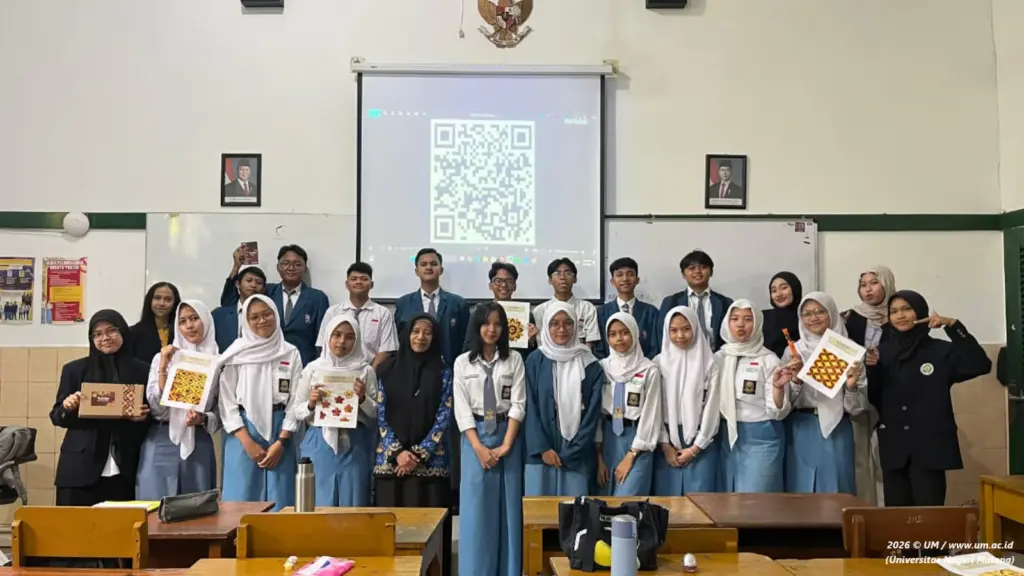
From a learning experience perspective, approximately 89% of students felt that BATIKIN helped them understand chemistry and connect it to daily life. Furthermore, 73% of students strongly agreed that learning chemistry through batik culture made the material more interesting and less tedious. These results confirm that culture-based chemistry learning innovation can enhance students’ chemistry literacy while supporting SDG 4 through quality, inclusive, and meaningful education.
Editor: Muhammad Salmanudin Hafizh Shobirin – UM Public Relations